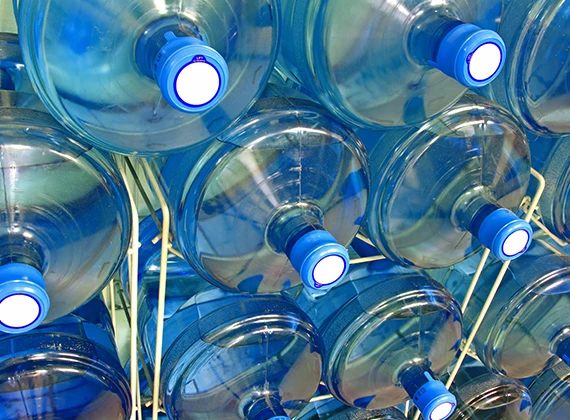
Planning deliveries and storage across an estate
- Delivery frequency should reflect each site’s actual usage, not one schedule applied to the whole estate
- Full and empty bottle storage needs planning per site, particularly anywhere space is tight
- Agree upfront what happens if a delivery is missed, or a site runs low unexpectedly
Culligan collects empty bottles as standard on every scheduled delivery, and delivery frequency can be adjusted as a site’s usage becomes clearer. Our bottled water delivery page covers how scheduling and adjustment work in more detail.
Manual handling across an estate
A full 19-litre bottle is a genuinely heavy lift at any single site. Across a whole estate, the more useful question isn’t just “is this bottle heavy”, it’s how many bottle changes are happening every week, and at which specific sites. That turns manual handling into something you can actually plan around, rather than a one-off consideration at installation.
In the UK, there isn’t a law regarding a universal safe lifting weight. That said, employers should avoid potentially hazardous manual handling where possible. Always assess the task, load, environment, and the individual who will be doing the lifting. Be particularly wary if your site is one where you expect heavy bottle handling to be a frequent task, and consider whether a mains-fed system may be better suited.
Who does what: central FM, local site, and Culligan
A clear responsibility split avoids the most common source of confusion in a multi-site programme: everyone assuming someone else is watching the stock levels.
| Task |
Central FM |
Local site |
Culligan |
| Contract and commercial terms |
✓ |
|
|
| Stock monitoring |
|
✓ |
|
| Bottle changing |
|
✓ |
|
| Delivery and collection |
|
|
✓ |
| Servicing and sanitisation |
|
|
✓ |
| Fault reporting route |
✓ |
✓ |
|
| Estate-level reporting |
✓ |
|
✓ |
Culligan’s centralised account management is built around exactly this kind of split, a single named account manager for the estate, with delivery, collection and servicing coordinated centrally so local sites only need to manage stock checks and bottle changes day to day.
Questions to ask us
When you’re evaluating your options, these are some questions worth asking us directly:
- Which areas do you serve directly, and where do you rely on a delivery partner?
- Is there one contract and one point of contact across all our sites?
- Can different sites use different products under the same account?
- Can invoicing be consolidated, and can costs be split by site or cost centre?
- How do you add a new site to the account, and how do you remove one?
- What happens if a delivery is missed?
- What service records do you provide, and how often?
- What are the exit or termination terms if you need to adjust?
Working out the true cost of a multi-site bottled-water programme
A useful comparison covers more than the headline rental or purchase price. Worth including in your own cost picture:
- Equipment, rental or purchase, per site
- Water and delivery, bottles, scheduled delivery, any emergency top-ups
- Service, maintenance, sanitisation, call-outs
- Internal admin, ordering, invoice processing, stock monitoring across the estate
- Change costs, adding, moving or closing sites
It’s worth noting which of these costs are common to bottled and mains-fed alike, water and delivery costs, for instance, don’t disappear just because a site switches format, so they shouldn’t be allowed to unfairly weight a comparison toward one option.
Adding, moving, and closing sites
We understand that facilities contracts change and buildings come under new management. What happens to existing equipment and stock? How does the account and invoicing update as a result? With Culligan, everything is managed from one account, so a simple conversation with your assigned account manager keeps everything up to date and clear when things do change.
Bottled, mains-fed, or both across your estate?
Most estates benefit from a mixed approach rather than one universal answer. For example, a head office may benefit from a mains-fed unit, while a handful of smaller or temporary sites may use a bottled water cooler. For the full comparison of how the two options differ, see our bottled vs mains-fed guide.
Renting or buying across multiple sites
Ownership model and water source are separate decisions. You can rent or buy either bottled or mains-fed equipment, and different sites in the same estate don’t need to make the same choice. Our rental guide covers what’s included and how the process works.